

I want to do things a little differently today. Instead of a three-point sermon, I have three mini-sermons. They’re not exactly connected to each other, except by the day. But I want to preface my remarks by saying that I hope they are all genuinely practical — because one of the things that has struck me after almost 30 years of being Orthodox is that it’s really not about the theology.
Now don’t get me wrong, theology is wonderful and important. If you’ve been attracted to the Orthodox Church because of the riches and depths of Orthodox theology, glory to God, that’s wonderful. But even for those of us who have fallen in love with Orthodox theology, the whole point of the Church’s teaching about who God is is so that we can work out our salvation in fear and trembling. It was one of the more disturbing realizations I had about ten years in, when I realized — I had converted to Orthodoxy because I wanted to be right — after all, this is the one true Holy Catholic and Apostolic Church — and that’s not a horrible reason for converting… But about ten years in, as we were reading and studying the sayings of the Desert Fathers, it suddenly struck me, powerfully: this is about me. It’s about me having to allow God to change me. And I really don’t want him to change me. I’m happy to repent of my sins to get rid of my guilt, but I don’t actually want to change. But that’s the whole point. The whole point of Jesus’ teachings is so that we can change and grow into the people God made us to be in the beginning. And we see that all through his ministry.
So I want to start with the Gospel reading we heard for the Icon Made Without Hands. I’m not going to talk about that particular icon — if you want to look up the story, go look it up, it’s pretty cool. But the reading itself has Jesus and his disciples going down to Jerusalem. It begins by saying that Jesus “set his face to go to Jerusalem” — which he would have had to do: he knows what is awaiting him there, and he knows that this was his ultimate destiny — this is what he has to accomplish, but it’s going to be pretty hard. So he has set his face steadfastly to go to Jerusalem, and he’s going in the most direct way possible: straight through Samaria.
I won’t belabor the point about the relationship between Jews and Samaritans, other than to remind you that one of the key contentions between them was, where do you worship? The Samaritans had built a nice temple on Mount Gerazim, but of course, the Jewish tradition was that you had to worship in the temple at Jerusalem. And so when the Samaritans saw Jesus and his disciples with their face clearly set to go to Jerusalem — this was obviously their destination: they’re going to Jerusalem to worship — they wouldn’t let them in. They showed them no hospitality. They essentially (whether literally or figuratively) slammed their doors in the disciples’ faces.
The disciples were distraught. Even given the horrible relationship between Jews and Samaritans, one of the things that is absolutely sacrosanct across the ancient world is the duty to show hospitality to strangers. It was a sacred obligation. They didn’t have hotels — well, they had a few, but it wasn’t quite the same: if someone is traveling and needs a place to stay, it’s your job is to look after them, not to slam your door in their face.
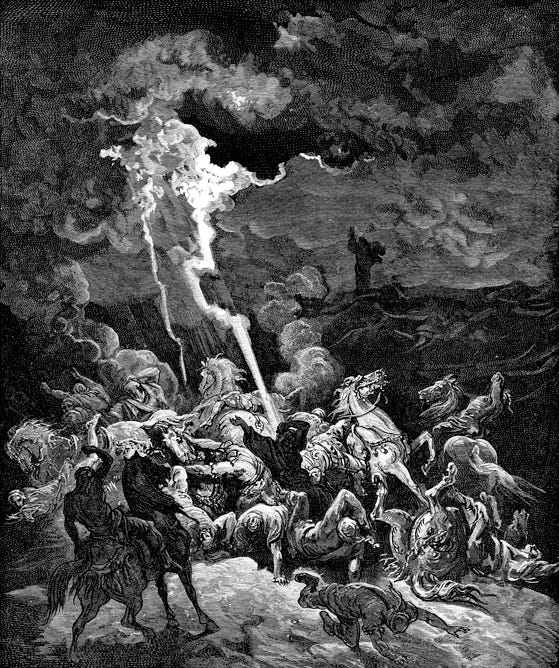
So the disciples are furious. James and John come to Jesus and say, “Do you want us to command fire to come down from heaven and consume them, just as Elijah did?” Now, Elijah did do this. When soldiers were sent to arrest him, he called down fire from heaven which consumed them. He was just one unarmed man — when you send a whole host of soldiers to fetch someone, you expect them to come back with their prisoner. But Elijah simply prayed, and fire fell down from heaven and consumed those who were sent to arrest him. This actually happened twice, because the king kept sending more soldiers. The third time, the officer sent fell down before Elijah and begged him not to call down fire, and Elijah was merciful. So this is something that God does, apparently, in certain circumstances.
And so the disciples felt it would be entirely appropriate for God to do the same here — to send down fire from heaven and consume those villages that had so rudely rebuffed the one they loved. Because, of course, it wasn’t just about them: the Samaritans had been horribly rude to the Christ, the Messiah. But Jesus turns to them and rebukes them: “You do not know what manner of spirit you are of. For the Son of Man did not come to destroy men’s lives, but to save them.” And they went to another village.
I love that last line. They just went to another village. Simple solution. And I think one of the things we can take away from this — particularly as Orthodox Christians, people who have found the one true Holy Catholic and Apostolic Church — is that there is a temptation to be a little triumphalistic, or to be very eager to guard the honor of the tradition we have inherited and come to love. And when people aren’t honoring that tradition, this can become our natural response: I’d like God to send down fire from heaven, and maybe not consume them, but at least show them that I’m right. But in that response, we show that we do not know what manner of spirit we are of. Because the Son of Man did not come to destroy men’s lives, but to save them.
And one thing especially important for those of us who are converts to Orthodoxy to remember is that we were wrong too, once. That’s why we’re here. If we don’t extend the same grace to those we’re talking with — or who are maybe trash-talking the Orthodox Church within our hearing — the same grace that God extended to us, then what manner of spirit are we of?
The second thing I want to say is something you have heard me say over and over again, and I’m going to say it again, because it is so deeply important for us as we work out our salvation in fear and trembling. It’s the other Gospel reading we heard today, from Matthew.
You know the story. A king decided to settle accounts with his servants. When he was going over the books, he found someone who owed him 10,000 talents — a debt on the level of a nation-state. The king calls him in and commands that he be sold, along with his wife, his children, and all that he has, so that some payment can be made. He’s not going to recover 10,000 talents from that, but at least he’ll recoup some of the losses. And the servant is obviously deserving of some punishment — I don’t know how he racked up a debt of 10,000 talents, but probably not by doing the right thing.
The servant falls down before him and says, “Master, have patience with me and I will pay you everything.” Which is, of course, ridiculous — there is simply no way he’s ever going to repay 10,000 talents. But the master is moved with compassion and releases him, forgiving him the entire debt.
So the servant goes out the door, thinking this is wonderful, he’s off the hook — and immediately spots a fellow servant who owes him money. Not an insignificant sum, but something like a third of a year’s wages. He goes up to this man, grabs him by the throat, and says, “Pay me what you owe.” The fellow servant falls down before him and says, “Have patience with me and I’ll get you the money.” And the servant who has just been forgiven 10,000 talents will have none of it and has the man thrown into prison.
The other servants see what has happened, and they go to the master and tell him everything. The master is unsurprisingly unhappy, and says, “You wicked servant, I forgave you all that debt because you begged me. Should you not also have had compassion on your fellow servant, just as I had pity on you?” And his master was angry and delivered him to the torturers until he should pay all that was due. “So my heavenly Father also will do to you if each of you from his heart does not forgive his brother his trespasses.”
I don’t know how much more solemn a warning we could receive from the mouth of the most compassionate man who ever lived. But if we do not learn to forgive, we will find ourselves in a hell of our own creation. There is a root of bitterness that grows in us as we refuse to forgive that will consume and destroy us, and make our life a living hell. And I don’t even want to think about what might come after. Jesus is warning us that it is absolutely, fundamentally, life-savingly essential to forgive as you have been forgiven. It’s right there in the prayer he teaches his disciples: “forgive us our trespasses as we forgive those who trespass against us.”
But forgiveness is hard. What prompts this particular parable is Peter asking how many times he should forgive his brother — seven times for the same offense? And Jesus says no. Seventy times seven. And, just in case Peter is thinking that’s 490 which is a lot but it is a limit, Jesus tells him the parable.
This is a parable I keep returning to because it is our greatest tool as we are learning to forgive, as we are struggling with forgiveness. Because forgiveness is generally not just an “oh yeah, I forgive you, it’s fine.” Maybe if someone steps on your toe, you’ll forget about it the next day. But if someone has done something life-altering to you, and you’re still living with the consequences, or perhaps you’re suffering repeated wrongs day after day — this is hard work. How do we do it?
The answer is this: remember what you have been forgiven. Have a correct understanding of just how much you have been forgiven. Because we don’t know the life circumstances of the people who are hurting us, or that we’re struggling to forgive. We’re not God. We don’t know them. But we do know our own life circumstances. We know all the grace that God has poured out on us day in and day out, month in, month out, year in, year out. We have experience of that. We’re alive. We’re drawing breath. We’re in this amazing world that he has created — despite the fact that we keep messing up, keep hurting other people, keep hurting ourselves.
God is merciful. That’s precisely why we have all those “Lord have mercy”s in the service — we need that reminder. That’s precisely why we have the rite of confession. Because as we examine ourselves and realize where we’ve failed and confess our sins, God is faithful and just to forgive us our sins and to cleanse us from all unrighteousness: that’s our 10,000 talents that we have been forgiven right there. That’s the depth of God’s love and mercy, his riches toward us, his kindness and compassion — freely given to us day in and day out. And that’s our basis for turning to our brother, our sister, the person on the street, the person who keeps hurting us over and over again, and saying: I’ll be patient with you. In fact, maybe I’ll even forgive you. Because God has forgiven me. As Jesus said to his disciples: freely you have received, freely give.
The third and last thing I want to say is this: all of this is really hard. This is not easy. Christianity is not for the faint of heart. As C.S. Lewis said, “it’s a fighting man’s religion.” We have to fight day in and day out. The Apostle Paul himself says: “keep fighting the good fight, do not grow weary in well-doing.” And we don’t always have a lot of encouragement, a lot of confirmation, and that’s precisely why we have the feast we have just celebrated, the Dormition of the Theotokos. We talked yesterday about the humility that was in Christ Jesus, and that was also in her, and that we are called to. But even that’s hard — more hard stuff. So what do we have in terms of reassurance?
What we have is precisely what we know about the fate of Mary, the mother of our Lord. When she died, the prophecy she herself spoke was at least in part fulfilled — that all would call her blessed. She was surrounded by people who loved and honored her. The apostles came to say farewell to her — or perhaps were brought, it’s not clear to me from the story I read, but it might even be that they were brought like the apostle Philip was when he was taken away after he baptized the Ethiopian eunuch, and just found himself over at Azotus where God wanted him next. Because one of the things that’s in there in the story is, as the apostles find themselves here, they’re all confused. “What? Why are we here?” And the apostle John says, “It’s the time for the Theotokos to depart. God has brought you here.” You can imagine that if they were plucked up and just kind of deposited there, they might be a little disoriented.
And as they have this beautiful funeral, saying goodbye to Jesus’ mother, Thomas — as usual — is late. He has some excuse; he’s over in India. He shows up after they’ve already laid her to rest, and he is absolutely distraught that he didn’t get to say goodbye. In the Christian understanding, the body is still a part of us — that’s why we bury rather than cremate wherever possible, honoring the body as a part of the person. So Thomas asks that the tomb be opened so he can say his goodbyes. And when they open the tomb, there is no body.
Because why would her Son leave her there in the grave?
The thing about Mary is that she is us. She is us, the Church. As we are the bride of Christ, she was, in a sense, the bride of God. And so what we see and celebrate in her is actually what we can anticipate receiving ourselves as followers of Jesus Christ, as those called to be God-bearers, called to be Theotokos. What is promised to us is that we will share in the resurrection that Jesus experienced, the resurrection of life that the Theotokos experienced.
This world is not our home. We are just passing through. It’s a beautiful journey, if only we have eyes to see it. And we can see it a whole lot better if we forgive, and if we are looking to seek and to save those who are lost — who are lost like us, and whom we can invite to come along with us on the journey. It is a hard journey. But at the end there is not only rest, but real, true resurrection: eternal life — that life we were made for in the beginning, that life that was in Christ, and being in Christ is also in his mother, and being in her is also in us, that is God at work in us, his children.
He will not abandon us to the grave. He will bring us into his presence, enabling us to stand before him and to give an account of what we have done with what he has given us, knowing that he is the compassionate master who forgives us as we fall down before him and worship and glorify him: Father, Son, and Holy Spirit, now and ever and into ages and ages.
Scripture readings referenced:
Luke 9:51-56; 10:22-24
Matthew 18:23-35


