

In today’s Gospel reading, we have a principle, a command that we all know, and we all know it super well: “Do as you would be done by.” The Golden Rule, right? And so I want to use the classic fantasy technique of defamiliarization today, and tell you a story. More specifically, a Minecraft story.
You may not know this, but in addition to being a priest and a teacher, I am also a Minecraft server administrator. This came about quite a few years ago now, when Minecraft was still a fairly new thing and everybody was like, “Oh, this is kind of cool.” And I thought, well, I’ll approach the principal of my school… I teach in a school that is a virtual school, if you will. We have students all over the province of British Columbia, so they don’t really get a chance to meet with one another. So the experiment I proposed to the principal was: “How about I start a school Minecraft server? It’ll be a nice virtual playground for everybody, and everybody will have a chance to actually meet with one another in this virtual world.”
For those of you who don’t know Minecraft, if you haven’t been paying attention over the last however many years, it is a game made up of blocks, and these blocks make up an entire virtual world, and everybody can come and join in and work together and play together in it. So my vision was for a community of students who would be working together and playing together and having a good time together in this little virtual world. And I was the one who was going to create the world for them.
In the context of this story, without intending any disrespect, of course, to the Creator, I am God. Because I actually have creative abilities. If you know Minecraft, you know there’s survival mode and creative mode. Everybody in this world was in survival mode, except for me. I’m the creator. And so I started up the server, and it was good.
The students would join in and they’d be working together and playing together, and I’d come bounding across the grass to them: “Here, have a pickax, or here, have a hoe, or here, have a shovel.” Everybody worked and played together, and in the midst of what I called Diamond Town, I built myself a nice large tower, and I put in the tower for myself a diamond throne. And it was good.
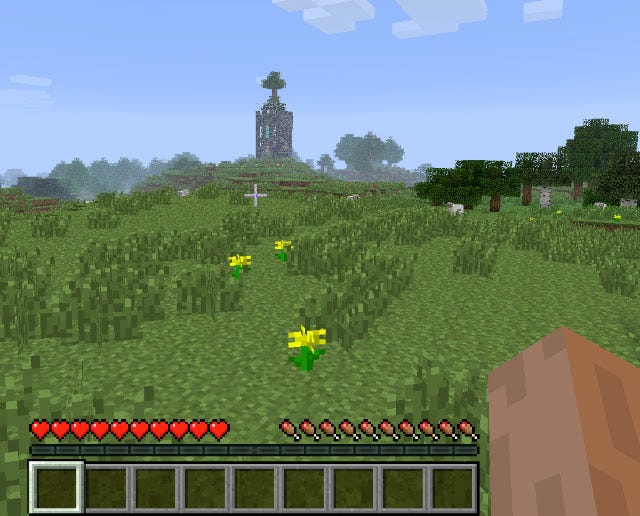
Then I went away to explore various regions, and when I came back to my tower, to my diamond throne, the tower was exploded, and the diamonds were stolen.
Now, all of a sudden, this idyllic world, in which I had been building a community where everybody had been working and playing together very happily, was really, irretrievably, irreparably destroyed. Because rebuilding the tower and the diamond throne was, for me, the work of a moment. It didn’t matter. I can almost snap my fingers — well, do a few clicks of the mouse — and it’s all back to normal. But what I could not repair was the relationship that had been destroyed by this act.
So I rebuilt the diamond throne, but now this was looming in the background, and I went away again and was exploring different regions of the world. And then one of the students — I had a little newspaper that I had these students make, called the Almost Daily News, which was basically just blog posts — posted that someone was trying to assassinate the king. That’s me.
When I came back and started to investigate, I found this. If you know Minecraft, if you die, you respawn at whatever place you last had your bed. And right over top of my bed, at the top of Diamond Tower, was a continuous fall of lava. So if I had died and respawned, I would have been stuck in an infinite, horrific, hellish, eternal loop of: “Oh, I’m back. I’m dead. Oh, I’m back. I’m dead.” Very clever, if you stop to think about it.
Then something happened that I didn’t anticipate. The relationship had been damaged, but now everybody in the server was wondering who did this. I didn’t have the investigative tools that I have now, so there was no way to determine who did it. But everybody wanted to know. And anything else bad that happened in the server was automatically assumed to be the same person. So there was a witch hunt going on. “It was you!” “Oh, no, no, it was you. I saw you skulking around Diamond Tower.” It was getting out of hand.
And so I finally figured, okay, I’ve got to deal with this. I did two things.
First, I replaced the entire Minecraft world with a bedrock box — just as boring as you could possibly get in Minecraft, because you can’t actually interact with bedrock — with signs all around the box saying, “If you continue to bite and devour one another, beware lest you be consumed.” If you know your Scriptures, that’s from Galatians, the Apostle Paul. The next time they logged in, they were like, “Whoa, what’s going on? Where’s the world? This is not good. This is looking kind of boring and horrible and hellish.” And I think they got the message.
But I knew I also needed to do one more thing. I needed to get everybody participating in this world to make what I called The Commitment. And here’s the tie-in to the verse. I didn’t want to actually do the verse, so: “Respect one another’s in-game persons and properties at all times.” If you’re playing on my Minecraft server, the TLA Minecraft server, at the school I work for, you can only do so if you make the commitment to respect one another’s in-game persons and property at all times. In other words: “Do as you would be done by.”
As I say, this was an experiment, and this is a school, so this is all supposed to be somehow educational. I got the students to reflect on the experience. From that point on, I enforced this commitment pretty carefully and pretty rigorously. I also introduced new tools so that I could actually see what people were doing in the server. If somebody did not abide by The Commitment, and was stealing from another player or doing something like that, I would kick them out of the server. Excommunication, of a sort? And the idea was always: you’re out for now, but you need to reaffirm your commitment to The Commitment, and if you do this and you apologize, then you’re welcome back. That’s the whole point, really, of excommunication.
With this in place, I was maybe just a little bit worried, because I did have to come down fairly hard on certain students, who possibly were the ones who tried to assassinate me. Towards the end of the year, I asked the students to reflect on what they had learned from all this. And what I was actually really surprised by, and probably shouldn’t have been, given my experience as an Orthodox Christian priest, was that they were very appreciative of the enforcement of the law in the server. Because, they said, it made this server, this world in which we were all interacting with one another, a safe, enjoyable place to play with one another.
So we have to think for a moment about how this works with us as human beings. Because of course, we have done the same thing. We don’t really want to do what God tells us to do. In fact, we’d almost like him not to be there at times, especially when we’re doing what we’re not supposed to be doing. And so God, of course, has introduced this thing called the Law.
The Law was given by God to the people of God at Mount Sinai for their good. To establish a community in which the people who participated would all be committed to this set of rules, and would understand and know how to conduct themselves and how to love one another. Here’s what the expectations are. They’re really clear. This is why the Israelites, God’s people, always understood the Law as something good. Jesus himself says that the Law is good.
But of course, there are a lot of laws, right? You have the Ten Commandments, and then you have a few more and a few more, and by the final count, it comes up to, I’ve been told, 613. I haven’t counted myself, but that’s a fair number of laws to keep track of. So there’s that problem — the problem of increasing complexity.
But there’s another problem, maybe even deeper and more subtle. As soon as we have the law — and any firstborn child will know this — the law is an excellent weapon to use against your younger siblings. “You can’t do that. Mom and Dad said no, you can’t do that.” And you become the enforcer. (Not speaking from experience or anything, as a firstborn child…) But that is one of the dangers of the law: we end up trying to use it against one another, when that was not the point of the law from the beginning. The point of the law from the beginning was love. To teach us how to love one another.
And so, when Christ comes, he gives us a nice, simple, boiled-down, easy-to-understand version of the law: “Just as you want men to do to you, you also do to them likewise.” But the context is actually important here. Because this is Jesus giving the Beatitudes. This is the Sermon on the Plain, in Luke’s Gospel. He has just said what we heard sung so beautifully in the Beatitudes. And having given the Beatitudes, he ends, as in Matthew, with:
Blessed are you when men hate you, and when they exclude you, and revile you, and cast out your name as evil, for the Son of Man’s sake. Rejoice in that day and leap for joy, for indeed your reward is great in heaven, for in like manner their fathers did to the prophets.
Wait. Rejoice when people are misrepresenting me? Slandering me? Saying horrible things about me?
Then he goes on to say:
Woe to you who are rich, for you have received your consolation. Woe to you who are full, for you shall hunger. Woe to you who laugh now, for you shall mourn and weep. Woe to you when all men speak well of you, for so did their fathers to the false prophets. But I say to you, love your enemies.
Wait, wait. My enemies? The ones who are out to do me harm, who are out to deliberately hurt me, possibly even to kill me? This is potentially suicidal. How are we supposed to love our enemies? This makes no sense. “Do good to those who hate you.” What?
Bless those who curse you. Pray for those who spitefully use you. To him who strikes you on the one cheek, offer the other also. And from him who takes away your cloak, do not withhold your tunic either.
From him who takes away your diamond pickaxe, do not withhold — I don’t know, whatever other valuables you have accumulated in Minecraft.
Give to everyone who asks of you. From him who takes away your goods, do not ask them back. And just as you want men to do to you, you also do to them likewise.
That framing actually changes it, when you stop and think about it. Because it’s a deliberate move on our Lord’s part. He’s addressing this weaponization of the law that is all around him in his day. And he’s saying, “That’s not the point. You’re missing the point, people.”
Of course, we are surrounded by people who do horrible, nasty things to one another. Why? Why do people do these things? Well, as Father Thomas Hopko used to say, “Hurt people hurt people.” People who have been hurt tend to turn around and inflict the same hurt on one another. Every now and then you get somebody who’s more or less pure evil — Adolf Hitler, of course, comes to mind. But most of the time, most of the people who are hurting you have themselves been hurt, and the hurt they are inflicting on you is coming at you from wherever they’ve come from. It may be deliberate. But how does it help if our response is a witch hunt? How does it help if our response is to hurt them back? “An eye for an eye and a tooth for a tooth” — great. Now everybody’s blind and toothless.
So what Jesus is saying here is that “do as you would be done by” is not simply a matter of doing good. “Love those who love you. … Do good to those who do good to you. … [or] Lend to those from whom you expect to receive something back.” Even sinners, as he says, do the same thing. But if you are going to be children of your Father, children of God, who created and sustained and continuously sustains the universe in its existence, then you need to love your enemies. Do good and lend, hoping for nothing in return. And your reward, as he says, will be great, for you will be sons of the Most High. “For he is kind to the unthankful and the evil.”
Have you ever looked around and noticed how many horrible, evil people there are walking around who have not been struck by lightning yet? I mean, God obviously isn’t doing his job. He should be throwing a few more lightning bolts from heaven and smiting those who are doing that evil thing or that horrible thing. He’s not. What’s going on here? Why isn’t he? I mean, he is righteous. He is holy. He takes sin very, very seriously. You see that in all the stories about the children of Israel. You see it even in the early stages of the Church.
What’s going on here is that God is not willing that any should perish. He wants all to come to salvation and to the knowledge of the truth. He wants the community that he set out to create at the beginning of the world. He wants us to be one, as he, the Holy Trinity, is one. That’s what he’s calling us to. That is the life of love and self-sacrifice that he is calling us to enact. That is who he is calling us to become: his own sons and heirs, his own children. Creatures like himself, who are willing to be kind to the evil and to the unmerciful, because we, too, want their salvation. Because we, too, actually love them. “Therefore be merciful, even as your Father is merciful.”
This is what we have to commit ourselves to. This is the way of life that Christ reveals to us and calls us to, so that we can truly be the children of God. And it is really the only thing worth doing.
It’s going to be messy. As a many-years-long Minecraft server administrator, I can tell you it’s always messy. “Okay, come on, I told you that already. Get out.” Write a letter to the parents. “Okay, this is what your child is doing.” And then, okay, now we get them back in. It’s messy.
The Church, likewise, is messy. We keep stepping on one another’s toes. We keep hurting one another, because we’ve been hurt. We’re not fully healed yet. And so we have to enact this, especially here in this community: do as you would be done by. As you want others to treat you, so you treat them: with love, with compassion, with generosity, with mercy, with forgiveness.
And as we do this, we will be becoming the community that God has called us to be, for which he has called us into being. We will begin that right here and now, that process of becoming one as Christ and his Father are one. And that makes this place the beginning of the kingdom of heaven, here on earth, to the glory of God the Father and of the Son and the Holy Spirit, now and ever and unto ages of ages.


