

Today, as we got to induct a new catechumen, I got to say one of my favorite lines — addressed to Satan — saying: “Call to mind him who commanded you to enter into the herd of swine,” and “your power, which has not power even over swine.” And we got to hear the Gospel reading that talks about exactly that.
This passage comes up fairly frequently in the Sunday readings, and I wonder if it’s because the early Church had a fair number of catechumens being inducted, so either the reference or the Gospel would have been particularly relevant to them — maybe more obviously so in those early days than it is to us. We tend not to think terribly much about the spiritual world and its existence and its impact on us. In those earlier days it seems to have been a little more “in your face”, because Jesus encountered a great many people who were oppressed, tormented, or even possessed by demons — and he delivered them all. As we heard in the other Gospel reading too: all who came to him with sickness or who were tormented by unclean spirits were healed.
I want to talk today about that healing which is available to us through Christ — that power over the unseen world that is ours in him. But I’ll also add a small footnote from one of my mentors, C.S. Lewis. If you haven’t read The Screwtape Letters — which are obviously not real, but actually very real correspondence between a senior tempter and a junior one on how best to tempt human beings — you should read it. One of my favorite parts is where the demons are lamenting the fact that they have to go hidden for now; it’s their new strategy, so that people won’t clue into the spiritual struggle going on that they are involved in. They don’t like flying under the radar, but that’s what they have to do now.
So I want us to look at the second Gospel reading we heard, the one from Luke, which also references unclean spirits, in light of the first. This is where Luke talks about Jesus coming down to a level place — if you feel like harmonizing the Gospels, maybe it was a level place on a mountain; if you’re not too worried about it, as the ancients weren’t, you can assume that the exact location of this sermon doesn’t really matter. Or you could note that Jesus, as a teacher, would have said the same things in multiple places — it doesn’t really matter. He comes to a level place with his disciples and
a great multitude from all Judea and Jerusalem and from the seacoast of Tyre and Sidon, who came to hear him and to be healed of their diseases, as well as those tormented by unclean spirits. And they were healed. The whole multitude sought to touch him, for power went out from him and healed them all.
The first thing to note here is that Jesus has power not only over unclean spirits but over sickness — and, as we know, even over death. He has the power of life at work in him because he is the source of life, and evil cannot stand in his presence.
But the next thing I want us to think about is how this works. Because we know something about evil, even if we haven’t had a scientifically verifiable encounter with the supernatural — we know about evil because it’s right here in our own hearts. And so we need to understand what Jesus teaches us not only about evil, but about the far greater power of good.
Having healed them all and cast out the unclean spirits, he lifts up his eyes toward his disciples and says:
Blessed are you poor, for yours is the kingdom of God. Blessed are you who hunger now, for you shall be filled. Blessed are you who weep now, for you shall laugh.
I’ll pause there. Being poor, being hungry, weeping — these are not states that the people of Israel would traditionally have considered states of blessing, states in which one experiences the presence — and the outpouring of goodness that is the presence of God. And yet Jesus is very obviously addressing this misconception.
We can think about it in terms of what Jesus says elsewhere about what happens when a spirit is cast out. He describes it as a house emptied of its ugly, horrible presence, swept clean. But then the evil spirit comes back, finds the house empty and swept, and invites seven others like himself to come and inhabit the house — inhabit the person with him. And the last state of that person is worse than the first. So even as Christ manifests his power over evil, he wants to protect his disciples from the sources of that evil. And part of the source of that evil is this misconception: if you’re poor, if you’re hungry, if you’re weeping, if people don’t like you — obviously you’re not blessed of God, obviously God’s presence is not with you. And Jesus says no. You who are poor now are blessed, for yours is the kingdom of God. You who are hungry now are blessed, for you will be filled. You who weep now are blessed, for you will laugh. And you who are hated by men when they exclude you and revile you and cast out your name as evil for the Son of Man’s sake — you are also blessed. You should be rejoicing and leaping for joy in that day, for your reward is great in heaven; for in like manner their fathers treated the prophets.
We cannot judge the presence of God, or even the blessing of God, by our physical circumstances or even by our feeling of his presence or absence. Our theology needs to go deeper than that. Christ is teaching us to understand the goodness and power and love of God — that he is at work even in these unfavorable circumstances. And one thing this does in terms of spiritual warfare is it fortifies us against the weapons of the enemy: fear and despair.
Fear and despair can easily overwhelm us, so that we feel that it’s all over, it’s all a lie, and that puts us into a state where we are vulnerable to temptation, and more than that, into a state where we actively pursue things in a way that is evil. If we are afraid of poverty, what does that tend to look like? Greed. Avarice. Acquisitiveness. We need more, and just a little more, and if I have a little more I’ll be safe. If we’re afraid of hunger: gluttony — I’ve finally got a chance to eat, I better eat as much as I can right now. Or fear of mourning and sadness — there are all sorts of responses here: think of things like PTSD, or our tendency to entertain ourselves to death, just filling ourselves with laughter. And the fear of man: if you’ve ever seen a people-pleaser, that’s the ultimate back-and-forth — like that fable of the man and the boy and the donkey, where everyone keeps complaining about who’s riding and who isn’t and who is carrying what, until in trying to please everyone they end up with the donkey falling off a bridge. Trying to please people is also an opening for the enemy.
But if we do not fear these states — if we understand that even in poverty, hunger, weeping, we are blessed by God; if we know that God will not leave or abandon us in these states but will bless us and fill us and give us what we need: our daily bread — then we are freed from that fear, freed from that despair, freed from the clutches of the enemy.
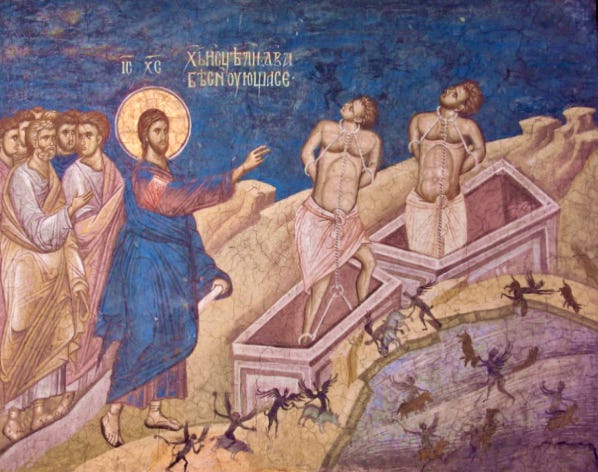
And that’s precisely what Jesus did with the demon-possessed men. He simply manifests his power. The demons, even as he’s approaching, are afraid of him: “It’s not time yet! Don’t cast us into the abyss — there are pigs over there, send us to the pigs.” He says one word: “Go.” They go into the pigs, and the pigs are sensible enough to run down the slope and drown themselves. Probably not what we should do, but I guess pigs can. And so the demons end up with no place to be anyhow.
This does mean that a whole crowd of people come, and they’re really annoyed with Jesus, and those people rather fulfill what he goes on to say next. We didn’t read this part, but it’s relevant, so I’ll read it now. After all these blessings, Jesus also pronounces a number of woes:
Woe to you who are rich, for you have received your consolation. Woe to you who are full, for you shall hunger. Woe to you who laugh now, for you shall mourn and weep. Woe to you when all men speak well of you, for so did their fathers to the false prophets.
If we think about this in terms of the other Gospel reading — what were these people thinking, these folks who were really annoyed that all their pigs were now floating dead in the lake? Their conclusion was to ask Jesus to leave: “Get out of here, we don’t want you, this is too expensive.” These are precisely the people against whom these woes are pronounced. They had lots of stuff — before the pigs went into the lake, anyway — they were full and didn’t need anything, they certainly didn’t need Jesus around. And they were rejoicing; now they’re mourning over the loss of their pigs. That’s the fulfillment, or partial fulfillment, of these woes. And Jesus simply complies, because it’s not his job at this point to dispense judgment. He has come to reveal the blessing and the grace of God.
So what does he tell us to do? How do we actually live out this reality of blessing, this understanding that God is providing for us and will continue to provide for us, that he will look after us as his children, and be with us as his children, through thick and thin? If we have this realization, he says:
I say to you who hear, love your enemies, do good to those who hate you, bless those who curse you and pray for those who spitefully use you. To him who strikes you on the one cheek, offer the other also; and from him who takes away your cloak, do not withhold your tunic either. Give to everyone who asks of you, and from him who takes away your goods do not ask them back. And just as you want men to do to you, you also do also to them likewise.
If we are living in this state of blessing, if we are living in anticipation of the goodness of God, if we are living in the knowledge that no matter what happens God is with us and we are blessed by his presence, then we have the power to resist evil — not with evil, but with love. And that is the only ultimate way to defeat the spiritual enemies who are our only real enemies. That love which is willing to sacrifice what I have and share it with you when you are in need. That love which turns the other cheek when someone slaps you, which does not go for an eye for an eye and a tooth for a tooth lest the whole world be blind and toothless — but which instead returns good for evil, love for hate. Because love is stronger than hate. Good is the only thing that is eternal, and it is worth even laying down our lives for, because we know that Christ is risen, and God himself will not abandon his followers — we, his children — to the grave.
Christ is risen!
Scripture readings referenced:
Matthew 8:28-9:1
Luke 6:17-23


