
We were blessed to have Reader James Mullin, our local expert in the Celtic saints, give the homily on the feast-day of All Saints of Britain and Ireland:
The Scriptures say, “Be still and know that I am God.” The Scriptures also say, “In repentance and rest is your salvation; in quietness and trust is your strength.”
Today I find it ironic that I want to talk about a wonderful, holy Christian virtue by using words, when what I want to talk about is the importance of quietness and silence and waiting upon God. So instead, what I shall do is use the example of Holy Saint Cuthbert of Lindisfarne, one of whose primary virtues — he spent many years as a hermit — was an adoration of waiting upon God in quietness, meekness, and stillness. I also thought it appropriate, given that today is the feast of all saints of Great Britain and Ireland, or as I like to call it, all the Celtic saints. Ironically, St. Cuthbert was more along the lines of what we’d call Anglo-Saxon.
As a young man, Cuthbert loved to play games. He was obsessed with games, loved winning, and was very good at sports — and he didn’t take life very seriously. One day, when he was about nine or ten years old, a little three-year-old boy came out to the field where he was wrestling, looked up at him, and said, “Cuthbert, why are you wasting your time with this? Do you not know these foolish games will pass away? You were called to be a holy man of God.” Cuthbert was shocked that a three-year-old would say this to him. (If a three-year-old came up to me and said, “Reader James, you’re wasting too much time on the internet watching food channels — you should be in prayer and study for your service to the Lord,” he’d be right, but I’d be stunned too.)
So Cuthbert started defending himself, saying he was just having a little fun — and indeed, it’s fine for a child to have fun. But he was getting to an age where he was expected to take on some responsibility, to follow his Christian life and virtues and help his family. Then the boy started crying, and Cuthbert noticed the tears and stopped. He chose silence instead of continuing to defend himself, apologized, and listened to the boy, who again affirmed: “You saddened me, because you’re called to something great.” From that day forward, Cuthbert took his faith extremely seriously.
Later, in his teen years, he was out in the field as a shepherd with other shepherds. It was quiet — just the bleating of sheep — when he noticed a beam of light coming down from the sky, and then saw a man going up on that beam of light. He said, “God, I see this — I know you want me to follow you,” and he decided that his calling was to become a monk and follow the Lord with his life. The next day, people told him that St. Aidan of Lindisfarne had passed away.
A couple of years ago, in my last sermon, I talked about Holy St. Aidan of Lindisfarne. My patron, St. Columba, brought the gospel to the Picts in Scotland and ministered to the Irish Christians in a place called Iona. St. Aidan, as a young monk, learned there and felt the calling of the gospel to go to the Anglo-Saxon peoples in Northern England. He followed that call and built the church there, and built Lindisfarne. So Cuthbert, himself an Anglo-Saxon, was following in those same footsteps, continuing the mission of his forefathers. What I love about that is the demonstration of continuation — we plant a seed, someone else waters it, and then they take seeds and plant them elsewhere, to the glory of the kingdom of God.
So Cuthbert decided to go find a monastery and began checking out different ones. At one, he was on the other side of the River Tyne from the monastery, and the monks used to gather wood and bring it down on rafts. On this particular day it was stormy, with heavy wind blowing the rafts out toward the river mouth and out to sea. One poor monk was on a raft without his pole, in real trouble. The people in the village on the other bank started laughing and jeering at the monks, saying their God, their Christ, was useless — it doesn’t mean anything. They had heard the gospel, but many of them were beginning to turn away, and seeing this they said, “Well, your God’s not doing anything.”
Cuthbert, who hadn’t yet become a monk, was distraught, and asked everyone to be quiet. He got them to fall silent, and said, “Can’t you even care about them as human beings? Don’t you want to see them safe?” Then he knelt down and prayed, and the sea became completely still. The rafts were blown back up the river to shore, and the monk on it reached safety.
He then journeyed toward what would be his first monastic home with his horse. On the way, hungry, he stopped at a house, and the woman there offered him hospitality and food — but he wouldn’t eat, wanting to keep the Friday fast. She told him there would be nowhere to find food on the rest of his journey, since the next habitation was too far away. But he decided to trust God and went on his way. Partway along, he grew very hungry — and was more worried about his horse than himself. He noticed an abandoned shepherd’s hut (it was fall, and the shepherding season was over) and went in to feed his horse some grass. The horse started nibbling at the roof, and suddenly a blanket fell down containing a hot piece of bread and some delicious food. I love that story — that little miracle. Who knows, maybe a shepherd left it there overnight; it’s up to you to decide. Either way, he finally made it to the monastery at Melrose, where he began his service.
His love of silence, of quietude, of listening, would pay off there. The older monks began to realize that they could talk to him and be truly heard, so he was made guest master, responsible for visitors to the monastery. He developed a terrible knee problem — a boil swelling up — and one day a wealthy man on a horse, all in white, came up to him at the foot of the monastery and asked, half in jest, “Would you like me to be your guest tonight?” Rather than dwelling on his pain or on this uninvited, presumptuous guest, Cuthbert said he would indeed love to host him. “Unfortunately, my knee is giving me trouble, but I will what I can.” The horseman told him to soak his knee in hot milk and wheat, then said he must be off, and left. Cuthbert and the other monks did as instructed, and he was healed — and it was later revealed that the horseman had been an angel of the Lord.
He went on with his duties, walking to various distant villages. In one village, some people were Christian, some weren’t, and some had begun returning to idols because of a plague. Instead of getting up on his high horse and shouting at the people for their sins, he went among them, asked them questions, and invited them to share their suffering and their story. Because he was able to listen and be quiet, he could hear not just their words but what lay behind their words. This repeatedly gave him the opportunity to share Christ and bring people back to the faith, or come to the faith.
Another time, Cuthbert woke one morning and went to the guest room to find a young man there. He said, “Oh, I didn’t know you’d come,” and wanted to get him food. The young man said that wasn’t necessary, but Cuthbert insisted, went out, and said the bread would be ready soon. When he came back to tell him the bread was almost ready, the young man was gone. He went to where the bread was, and one of the monks said he hadn’t even started baking that day — yet there were these incredibly beautiful loaves, which Cuthbert said were like the bread of heaven. So this was a man visited by angels more than once.
A little later, he became abbot of Lindisfarne — an island you can actually walk to at low tide, on the north coast of England, near Scotland. He was also made bishop, but he really wanted to spend time as a hermit, so he went to a nearby island called Farne, which was inhabited by demons. He cast out the demons, built himself a small hut, and then, wanting a place for his brothers to visit, built a little house for them as well. But there wasn’t enough wood for the floors. Some younger brother monks were visiting, and he asked them to gather wood lying down by the shore so they could make it into boards. Later they apologized — they’d forgotten, and the sea had swept it all away. He said it didn’t matter and prayed about it, and the next day the monks found the perfect amount of wood right in front of his hut, washed up by the ocean. Even the ocean listened to him — because of his holiness and devotion to God, but also because he listened to the ocean. He could be still and hear the lapping of water on the shore, and praise God for creation, honoring the majesty of the sea.
He would listen to animals too. His stillness and silence were a way of reconnecting with the gifts Adam and Eve had before the Fall — not looking at nature and creatures as something to exploit, but as fellow beings on this earth that we share with, which we are called to be stewards of and to be in relationship with. How we exist with creation is actually part of working out our salvation; we become more human in that interaction. Because he was quiet, listening, still among the animals, he was able to witness and observe their behavior, and they came to trust this little hermit on his tiny islet.
One day he noticed two ravens pecking at his roof, which was made of twigs and straw. He said, “Don’t do that — you’re destroying it. You need to go away.” And the ravens listened and left. Later, the same two ravens came back wanting to build a nest and have young. They stretched their wings out in front of him and bowed their heads to the ground, as if to say, “I’m sorry.” One of them gave a little push.
His boots were dry and cracking, as were the boots of monks who came to visit, and he had a piece of pork lard he would use to anoint them and keep the water out. And that’s another thing — when his fellow monks came to visit, he would wash their feet and anoint their boots with the lard. That relationship was possible because of his stillness before God; the animals felt safe because of his quietness and peace.
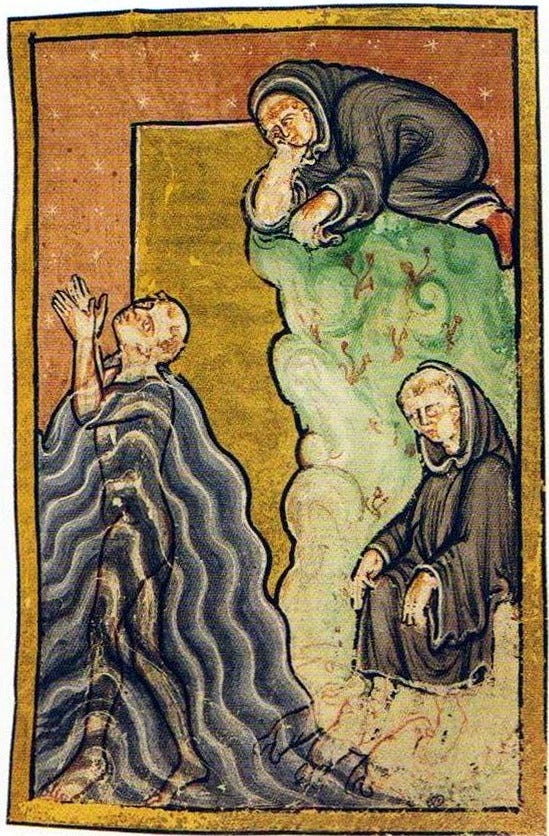
Another time, he was visiting a monastery near the sea and was asked to speak, which he did. Then at midnight he slipped out and went down to the ocean, wading in up to his chest to stay awake and simply be quiet and silent before God. A young monk, curious and a bit nosy, decided to find out what he was up to — wondering, half-suspiciously, what this Cuthbert fellow was doing out there. He watched all night and came to recognize the man’s holiness. In the morning, Cuthbert, chilled and cold, came out as the waters receded, and two otters appeared, came around his feet, and began drying them with their bodies. The young monk, watching from what he thought was a hidden spot, was amazed. He went back to the monastery, approached Cuthbert, and apologized, distraught. Cuthbert simply said, “I know what you did” — but he didn’t lash out in judgment. He only asked the young monk what he had seen, and what it meant to him. Out of that conversation, the younger monk learned some of the monastic disciplines and virtues he could carry forward. Cuthbert blessed him and told him not to tell anyone until after his death, because he didn’t want attention drawn to himself.
Another time, during a period when both the Irish monastic tradition and the Roman monastic tradition had taken root in parts of Northern England, a synod was called to decide which form should be followed. Rather than offering up his own opinion, Cuthbert — who was asked to be present — consistently reminded everyone to hear what each person had to say, and to think and speak in ways that were respectful and loving, aiming not for a majority vote but for a loving consensus. As time went on, he died in good grace, and the monastery continued, and Christianity flourished in Northern England and beyond.
So, back to today. We live in a world that’s so noisy. We have buildings being torn down and put up. We’re constantly bombarded, never wanting to be alone with silence — pulling out our devices, our phones, putting in our headphones whenever there’s a free moment. We’re a society constantly surrounded by noise, by social media.
Why do we do this? Why do we not spend time quiet and listening? I think, as a society, we’re uncomfortable being alone with silence, or even being together in silence. And the reason is that intentionally keeping silent sounds like an inaction — but some of the greatest Christian virtues are actually profound acts, even though they appear not to be an action at all. Silence is a surrender. It’s an opening of yourself, and in that space God can speak; in that place God can enter into you. That’s part of the acquisition of the Holy Spirit for us as Christians.
When we are silent, and more actively listening while others are talking, we can not only hear the words but understand what’s beneath them — rather than being motivated to throw in our own two cents or come up with an immediate rebuttal. Practicing quietness and true listening can build respect, love, and rapport. Maybe someone is having a debate and you have ideas of your own — what about the possibility of staying silent, listening to what people have to say, and choosing not to speak, going home instead to meditate on it? Then, given space, time, and thoughtfulness, you honor the people you’ve spoken with and can address things later with a better understanding of where they’re coming from.
Silence alone is very difficult, because it sometimes allows the Holy Spirit to show us where we are broken. Being alone with our own thoughts can be uncomfortable — but if we know what to do with that revelation of who we are, we can repent more fully and become healthier, and maybe even come to enjoy the quietude and silence.
Then there’s the silence of being with others in their mourning, in their suffering — when you have no words, when there are no words to say. Sure, you could offer a phrase of condolence, but sometimes the most powerful way of being with one another in suffering is to recognize: I can’t do anything about it. I can’t change the situation. I can’t say anything that will make it better. But I’ll sit with you, and I will be with you in silence, and I will mourn with you.
So, firstly: let us try to listen to nature — let us hear the voices of creation and have better fellowship with it. Secondly, let us practice silence and listening so that we may have greater connection and relationship with other human beings, with our brothers and sisters. Third, let us have silence within ourselves, that we may receive the Holy Spirit and be cleansed. And finally, let us keep silent with God, that the Father, Son, and Holy Spirit may enter into that silence and fill it with ultimate joy.